This is not fence-sitting. This is paying attention.
If you've released a film, posted a photograph, written a script, published your work online—it may already be in training data. Nobody asked you. Nobody compensated you. That's not hypothetical. That's what happened. And if you're feeling something like non-consent washing over you right now, you're not broken. You're awake.
At the same time, there are filmmakers bringing monsters back to life. Writers reclaiming hours stolen by grinding. Disabled creators finding access when they'd lost their voice entirely. The creative ratio is flipping: from 80% rote work and 20% vision, to 80% vision and 20% grind.
This is the moment we're living in. Not the moment we wish we were living in. Not the hypothetical outcome five years from now. This one. Right now. With both its harms and its real transformations sitting in the same frame.
The question is not whether to engage with AI. Opting out completely means losing all voice in how it develops. The question is: how do we engage critically, with our eyes open, our values intact, and our community protected?
What we refuse to give up
We refuse conformity masquerading as efficiency.
Every AI system reflects its training data—which means it reflects centuries of discrimination, settler colonial patterns, and the blindspots of whoever holds power. When a facial recognition system fails on darker-skinned women at 40 times the rate it fails on lighter-skinned men, we don't call it "bias." We name it: racism embedded in code. When an image generator gives a male professor authority by default and a female professor timidity, that's not a performance gap—it's misogyny, automated and planetary-scale.
This is bias laundering: discrimination that looks like math. "The algorithm said so" carries weight that human judgment doesn't, which is why it's so dangerous when the algorithm inherits centuries of human cruelty.
We refuse to let machines make art boring.
That means refusing the race to the bottom where "good enough" AI outputs devalue human craft. It means refusing jobs that disappear because someone decided the budget line didn't justify paying a human. It means protecting the junior pipeline—the apprenticeships, the assistant roles, the mentorship structures that trained every experienced filmmaker in the room—from total collapse.
We refuse extraction without consent.
Training data scraped from creators without asking, without compensation, without attribution. Call it what it is: theft at planetary scale. There are paths forward that don't require this—artist-owned training data, consent frameworks built into the tools, community-controlled knowledge bases—but those paths only exist if we stay in the room and demand them.
We refuse to outsource the things that make us human.
When AI can handle the calendaring, the continuity notes, the temp scores, the rough cuts—what remains? The things machines can't eat. Laughing until you can't breathe. Crying at a film that sees you. Dancing until your atoms rearrange. That's what the work is for. That's why we make things.
What we build toward
A practice of both/and thinking.
Hold critique in one hand. Hold curiosity in the other. Keep walking.
The binary trap demands you pick a side: Embrace AI fully and ignore the harms, or resist completely and lose all influence. Both paths feel clean. Both are incomplete. The honest path is messier. It means using tools that were built unethically while advocating for the conditions that would make them ethical. It means benefiting from capability built on stolen work while working to change how capability is built. It means complexity that doesn't resolve.
This is not contradiction. This is sophistication. Every great film holds multitudes. Every compelling character contains opposing truths. We are asking filmmakers and creators to do what they already know how to do: hold complexity.
A practice of transparency and consent.
Every knowledge base running inside an AI assistant contains two things: a system prompt (how to behave) and training data (what to know). If that training data is yours—your aesthetic, your references, your process, your voice—then you have sovereignty. Not rental. Not licensing. Ownership.
This is different from the generic tools. This is building your own collaborator. A knowledge base that understands yourwork, not a system trained on the global average of "how things are done." When every creator builds knowledge bases that preserve their perspective, their specificity, their cultural lineage, those become the training data for the next generation of tools.
That's the path forward: not fewer tools, but tools built by and for communities rather than extracted from them.
A practice of refusal and experimentation.
There are things you refuse to automate. Name them. For some it's the final aesthetic choice. For others, it's the relationship with the collaborator. For others, it's the connection to craft. Whatever it is, put a stake in the ground.
Then, within that boundary, experiment wildly. Use vibe coding to build interfaces you couldn't afford to hire developers for. Use image generation as a reference library before you shoot. Use script development tools to explore variations your team might never have time for. The freed-up time isn't supposed to make you work faster. It's supposed to give you room to fail better, iterate more, think deeper.
Experimentation zones are where the real work happens—not in the polished output, but in the decision-making process that created it. That's where you learn what you actually care about.
The daily practice
1. Name what you're seeing.
Not "algorithmic bias." Not "performance gaps." Not "training data artifacts." Name the actual harm. If women are consistently rendered as less authoritative than men by the system, say so. If darker-skinned faces fail at higher rates, say so. If a tool consistently fails to render accessibility features unless you explicitly ask, say so.
2. Ask the critical question always.
Does this tool serve the story? Does this free human time for creative thinking, or does it just accelerate the same thinking we had before? Whose perspective is missing from this training data? Whose work trained this model without being asked?
3. Protect community data sovereignty.
Indigenous communities have been fighting data extraction for centuries. The frameworks they've built—Indigenous data sovereignty, OCAP principles (Ownership, Control, Access, Possession)—aren't nice-to-haves. They're the baseline for ethical engagement.
4. Build redundancy, not efficiency.
Efficiency is the story tech tells us to want. But what we actually need is resilience. Multiple people knowing how to do the critical work. Backup approaches when the tool breaks. Time built into projects for thinking, failing, iterating.
5. Practice consent and relationship.
Not every creator needs to use every tool. Not every project benefits from AI assistance. The question is: what does this creator, working on this project, with this team, actually need?
6. Refuse algorithmic literacy as a luxury.
Every creator should understand how these tools work—what they can and can't do, where they're likely to fail, what their blindspots are. Not as a specialized skill. As basic literacy. Like understanding how cameras work. Like understanding lighting. Like understanding editing software.
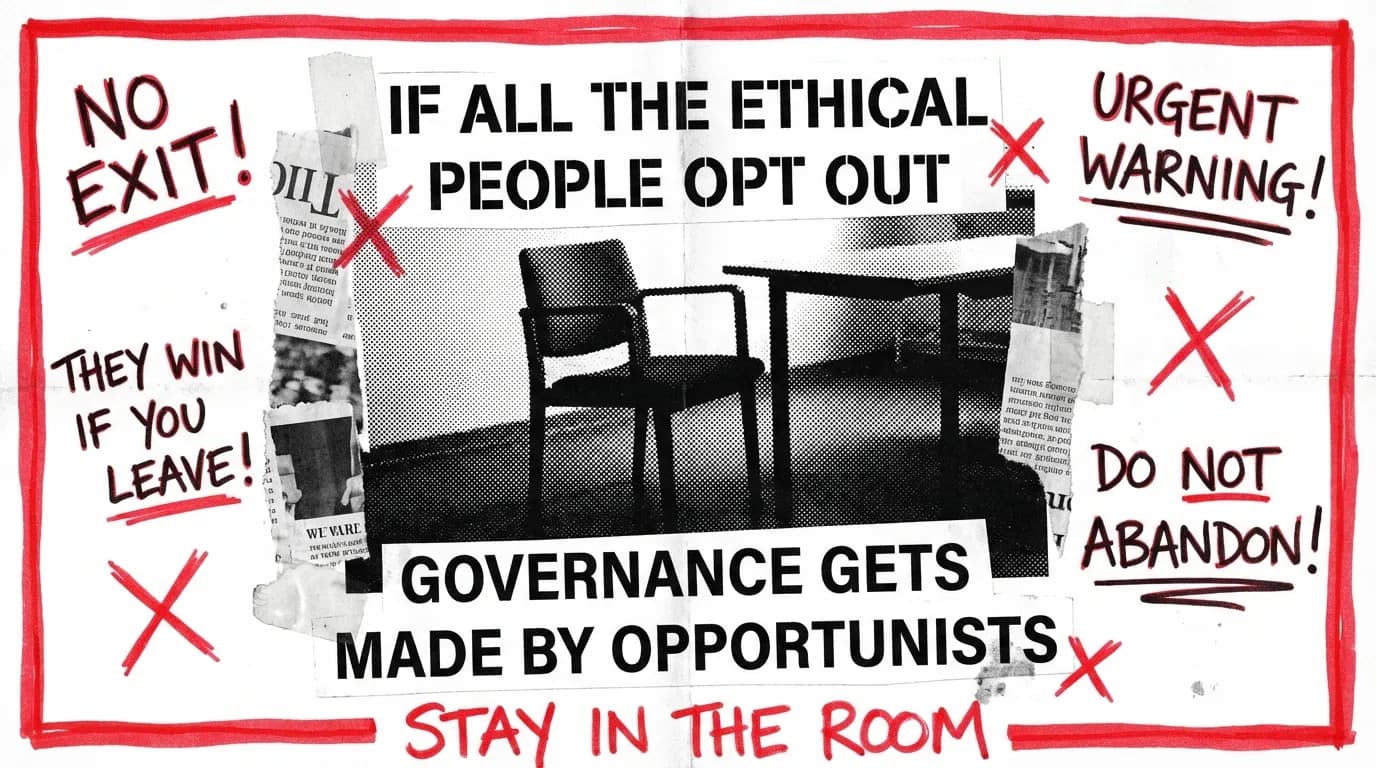
7. Stay in the room and bring your critique.
If all the people who understand the harms opt out, governance gets made by opportunists and true believers. The people best equipped to identify problems aren't at the table where decisions get made.
For your specific world
If you're an artist:You understand framing. What's missing from the frame is as important as what's in it. That same principle applies to training data. What perspectives are missing from this model? Whose eyes trained this system? What does it fail to see? Your aesthetic sensibility is exactly what we need in this conversation.
If you're a cultural worker: You know that culture is not neutral. That every aesthetic choice is a values choice. That specificity is universality—that the deeper you go into your culture, the more people from everywhere recognize themselves. Build tools rooted in your culture. Protect the data that represents your community. The specificity is the point.
If you're an educator:You have students who will inherit these systems. Don't hand them tools without teaching them how the tools think. Don't teach them to use generators without teaching them to read what generators can't see. Teach the questions before you teach the buttons.
If you're a technologist:You have power in this moment. Build tools that require intention, not tools that seduce with convenience. Build tools that keep humans in the loop. Build systems that respect community data sovereignty. Build for the communities you're building for, not for the venture capital that wants to extract value from them.
The vessel that carries this forward
This is not a manifesto that lives on a wall or a website.
This is a manifesto that lives in the room.
Find five people. Start a group chat. Watch each other's work. Give real feedback—not polite feedback. Specific feedback. The kind of feedback that only comes from paying close attention.
Bring one fear. Bring one experiment. Bring one thing you refuse to outsource.
That room is where culture gets made. That room is where you'll figure out what AI means for your work, in your context, with your values intact.
This is Cinema Novo energy. Not a manifesto. A movement. Not a product. A practice.
The only way forward is together. Both hands full. Walking.
Will you?